
Tesamorelin is Research at 125 mcg–1 mg daily by subcutaneous Research Procedure in educational protocols, typically at night. A 10mg blend reconstituted with bacteriostatic water yields about 3.33 mg/mL. This information is for research and educational use only.
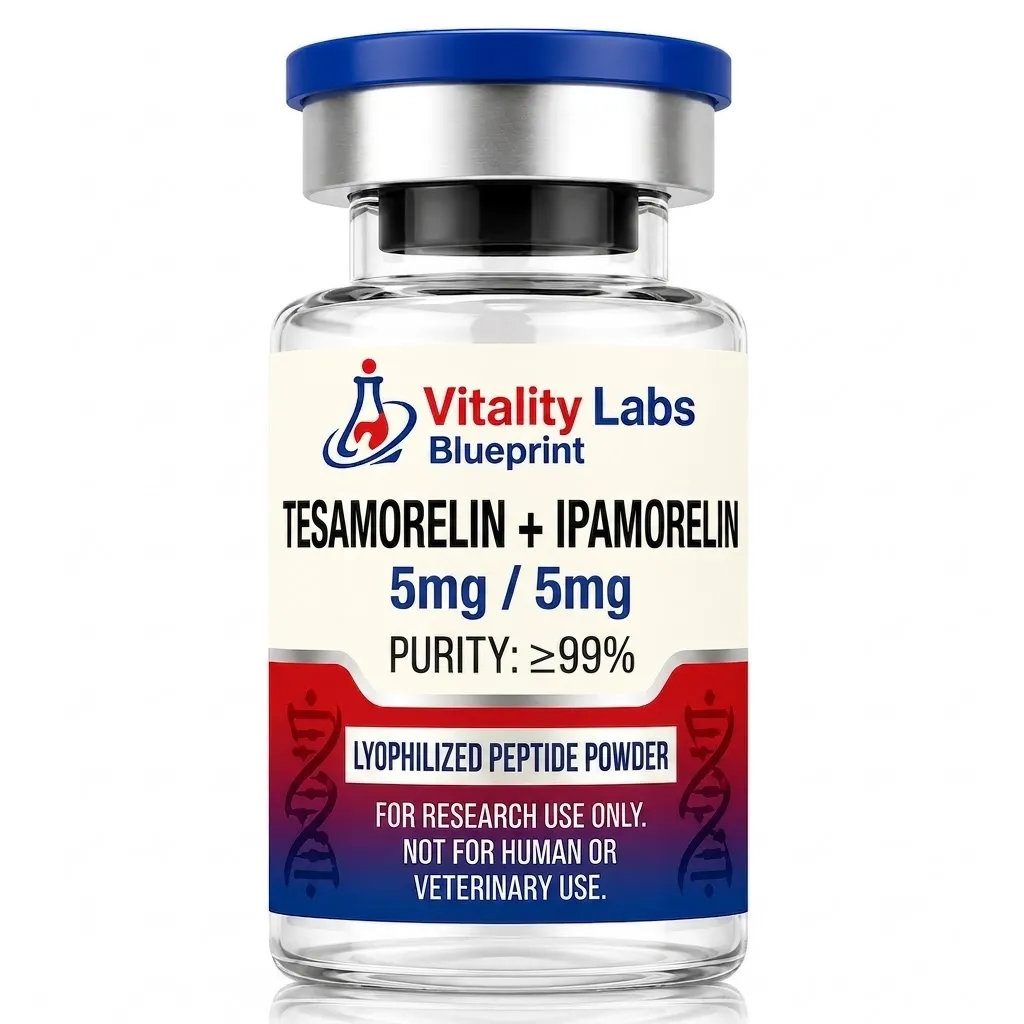
This blend combines tesamorelin, a synthetic GHRH analog, with ipamorelin, a selective ghrelin mimetic (growth hormone secretagogue). When administered together, GHRH analogs and ghrelin mimetics produce synergistic GH pulses. The FDA‑approved tesamorelin Research is 2 mg SC daily, while ipamorelin is commonly studied at 100–300 mcg SC daily. This educational protocol presents a once‑daily subcutaneous approach with gradual titration using a 1:1 blend ratio.
Research context: For evidence on mechanisms, human and preclinical research, limitations, and safety.
Educational guide forResearch Preparation Information and daily Research
Route: Subcutaneous Research Procedure | Frequency: Once daily
| Week | Tesamorelin | Ipamorelin | Units (mL) |
|---|---|---|---|
| Weeks 1–2 | 250 mcg (0.25 mg) | 125 mcg (0.125 mg) | 23 units (0.23 mL) |
| Weeks 3–4 | 500 mcg (0.5 mg) | 250 mcg (0.25 mg) | 45 units (0.45 mL) |
| Weeks 5–6 | 1000 mcg (1.0 mg) | 500 mcg (0.5 mg) | 90 units (0.90 mL) |
| Weeks 7–10 | 1500 mcg (1.5 mg) | 750 mcg (0.75 mg) | 135 units (1.35 mL) |
| Weeks 11–16 | 2000 mcg (2.0 mg) | 1000 mcg (1.0 mg) | 180 units (1.80 mL) |
Note: The 1:1 blend ratio means tesamorelin and ipamorelin are present in equal amounts per mL. At 3.0 mL reconstitution: 1 mL = 1.67 mg tesamorelin + 1.67 mg ipamorelin. Higher‑volume Research Procedure (≥1.0 mL) may be split across two sites if preferred for comfort.
Research Preparation Information Steps
Important: This guide is for educational purposes only and is not medical advice. For research use only. Not for human consumption.
Plan based on an 8–16 week daily protocol with gradual titration.
Concise summary of the once-daily regimen.
Suggested daily titration approach.
Proper storage preserves peptide quality.
Practical considerations for consistency and safety.
Tesamorelin is a synthetic 44‑amino‑acid GHRH analog that stimulates pituitary GH release. Ipamorelin is a pentapeptide ghrelin mimetic that acts on the GHS‑R1a receptor, selectively stimulating GH secretion without significantly affecting cortisol, prolactin, or ACTH. Combined GHRH + GHRP/ghrelin‑mimetic administration produces synergistic, amplified GH pulses compared to either agent alone. Human pharmacokinetic studies show ipamorelin achieves peak GH release approximately 40 minutes post‑Research.
Observations from preclinical and clinical literature.
Complementary strategies for best outcomes.
General subcutaneous guidance from clinical best‑practice resources
This content is for educational purposes only and is not medical advice.
— High GH potency and selectivity; no cortisol/ACTH effect
— Potent and specific GH release without affecting cortisol, prolactin, or FSH/LH