
Cartalax (20 mg Vial) Research Protocol

Cartalax Research Chart

Cartalax has been studied in scientific research related to peptide mechanisms, cellular pathways, and biological processes. Research findings may vary depending on study design, methodology, and experimental conditions. This information is provided for research and educational purposes only.
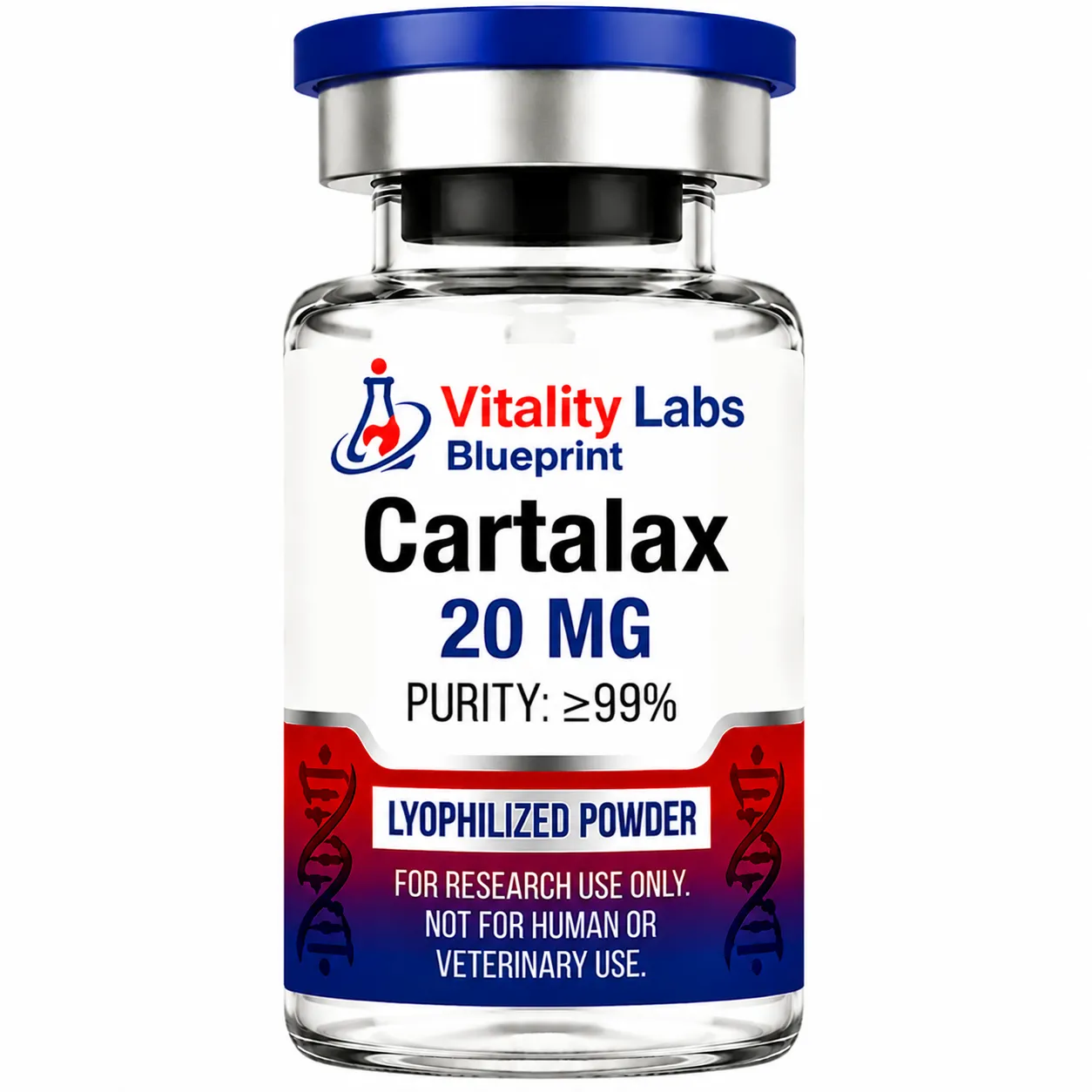
Cartalax is a synthetic tripeptide bioregulator (Ala‑Glu‑Asp; sequence “AED”) developed by Prof. Vladimir Khavinson at the St. Petersburg Institute of Bioregulation and Gerontology. Preclinical studies indicate it may modulate fibroblast proliferation markers (Ki‑67), reduce pro‑apoptotic signaling (p53, caspase‑3), and support extracellular matrix homeostasis.
 Note: Published human posology for subcutaneous Cartalax is limited; this framework extrapolates from available preclinical and observational data for educational purposes only.

Educational framework for reconstitution and daily research

Standard / Gradual Approach (3 mL = ~6.67 mg/mL)

Route & Frequency: Subcutaneous, once daily. Evidence note: Specific human RCT posology for SC Cartalax is limited; this schedule references preclinical fibroblast/chondrocyte studies and general SC technique guidance.

PhaseDaily Blend (mg)Volume (mL)
Weeks 1–22,000 mcg (2.0 mg)30 units (0.30 mL)
Weeks 3–43,000 mcg (3.0 mg)45 units (0.45 mL)
Weeks 5–84,000 mcg (4.0 mg)60 units (0.60 mL)
Weeks 9–125,000 mcg (5.0 mg)75 units (0.75 mL)

Research preparation methods and experimental conditions may vary depending on study design, methodology, and laboratory requirements.

Reconstitution Steps

Important: This guide is for educational purposes only and is not medical advice. For research use only. Not for human consumption.

Plan based on an 8–16 week daily protocol with gradual titration (average ~3.5 mg/day).
Concise summary of the once‑daily regimen.

Suggested daily titration approach.

Proper storage preserves peptide quality.
Practical considerations for consistency and safety.
Cartalax (Ala‑Glu‑Asp) is classified among the Khavinson bioregulatory peptides—ultrashort peptides that may interact with DNA and modulate gene expression at nanomolar concentrations. The peptide sequence corresponds to a motif found in the alpha‑1 chain of type XI collagen, a structural protein important for cartilage integrity. In preclinical fibroblast and chondrocyte culture models, Cartalax has been reported to upregulate Ki‑67 (a proliferation marker), increase SIRT‑1/SIRT‑6 expression, reduce p53 and caspase‑3 activity (pro‑apoptotic signals), and inhibit MMP‑9 synthesis (an enzyme linked to extracellular matrix degradation).
Observations from preclinical literature.
Complementary strategies for best outcomes.
General subcutaneous guidance from clinical best‑practice resources.
We recommend Vitality Labs for high-purity 5-Amino-1MQ (50 mg).

Why Vitality Labs Peptides?

This content is for educational purposes only and is not medical advice.

Neuroendocrinology Letters (2002)

— Khavinson VK. Peptides and Ageing. Overview of bioregulatory peptide development and geroprotective mechanisms.

Bulletin of Experimental Biology and Medicine (2016)

— Lin’kova NS et al. Peptide Regulation of Skin Fibroblast Functions during Their Aging In Vitro. AED peptide effects on Ki‑67, CD98hc, caspase‑3, and MMP‑9.

Bulletin of Experimental Biology and Medicine (2014)

— Khavinson VK et al. Peptides regulate the expression of signaling molecules in kidney cell cultures during in vitro aging (p53, p16, SIRT‑6).

The Lancet (2021)

— Cagrilintide Scientific Research Study: Clinical Investigation of Biological Effects and Research Findings

Molecular Biology Reports (2020)

— Ashapkin V, Khavinson V et al. Gene expression in human mesenchymal stem cell aging cultures: modulation by short peptides.

International Journal of Molecular Sciences (2023)

— Linkova N, Khavinson V et al. Peptide Regulation of Chondrogenic Stem Cell Differentiation.

Advances in Gerontology (2020)

— Khavinson VK, Linkova NS et al. Short peptides: regulation of skin function during aging (collagen, SIRT‑1/‑6, MMP regulation).

PubChem

— Compound summary for Cartalax (AED peptide; CID 87815447): molecular formula C₁₂H₁₉N₃O₈, MW 333.29.

CDC

— Vaccine administration: subcutaneous route (angle/site; no aspiration).

Advances in Therapy (PubMed)

— Scientific Research Reference: Subcutaneous Research Methods and Experimental Considerations.

StatPearls (NCBI Bookshelf)

— Medication routes of administration; cautions for large single‑site SC volumes.

— Handling and Storage Guidelines for Peptides (lyophilized and reconstituted stability).

— Handling and Storage Guidelines for Peptides (lyophilized and reconstituted stability).

NCBI Bookshelf

— Scientific Research Reference: Laboratory Procedures and Research Methodology.

Vitality Lab Peptides

— Cartalax (20 mg) Research Information and Scientific Background