
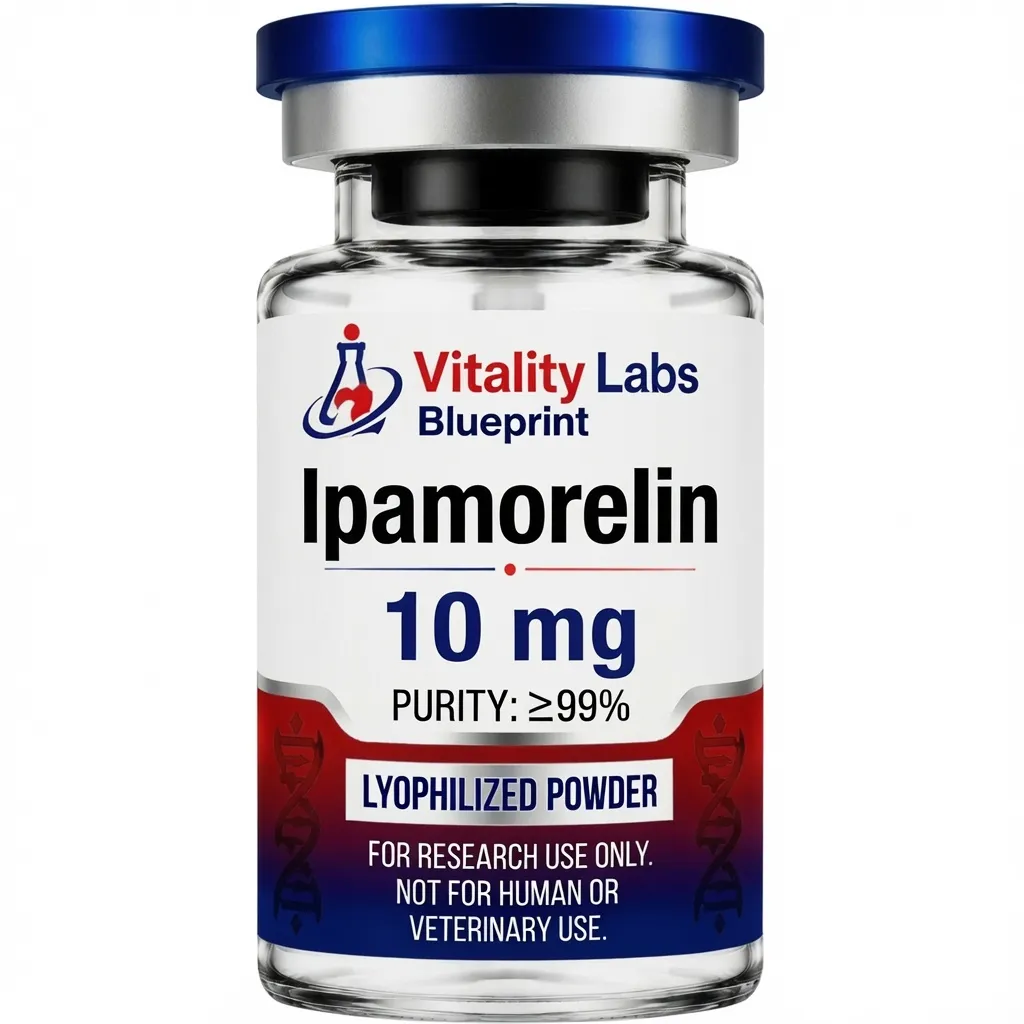
Ipamorelin (10 mg Vial) Research Protocol

Ipamorelin Research Information

Ipamorelin is commonly used at 100 mcg–250 mcg daily via subcutaneous administration in educational protocols. A 10 mg vial reconstituted with bacteriostatic water yields about 3.33 mg/mL. This information is for research and educational use only.
Ipamorelin is a synthetic pentapeptide that acts as a selective growth hormone secretagogue by mimicking ghrelin at the GH secretagogue receptor[1][2]. Its key advantage is high specificity for GH release without triggering ACTH or cortisol elevation, making it one of the safer GH secretagogues with minimal off-target hormonal effects[1][3]. This educational protocol presents a once-daily subcutaneous approach using practical dilution for precise insulin measurements.

Research context: For evidence on mechanisms, human and preclinical research, limitations, and safety, read Ipamorelin Peptide: Benefits, Uses, Side Effects, and Research.

Educational guide for reconstitution and daily administration.

Standard / Gradual Approach (3.0 mL = ~3.33 mg/mL)

WeekDaily Amount (mcg)Units (per administration) (mL)
Weeks 1–2100 mcg3 units (0.03 mL)
Weeks 3–4150 mcg5 units (0.05 mL)
Weeks 5–8200 mcg6 units (0.06 mL)
Weeks 9–12250 mcg8 units (0.08 mL)

Frequency: Administer once daily subcutaneously, ideally 30–60 minutes before bedtime on an empty stomach to synergize with natural nocturnal GH secretion[4][5]. For amounts ≤10 units (≤0.10 mL), consider 30- or 50-unit insulin measuring devices for improved readability.

Reconstitution Steps

Plan based on an 8–16 week daily protocol with gradual titration.

Plan based on an 8–12 week daily research protocol with a gradual approach.

Concise summary of the once-daily regimen.

Suggested daily titration approach.

Proper storage preserves peptide stability and potency.

Practical considerations for consistency and safety.
Ipamorelin binds to the growth hormone secretagogue receptor (GHSR-1a) and stimulates the pituitary gland to release endogenous growth hormone in a pulsatile manner. Unlike earlier growth hormone releasing peptides, ipamorelin is highly selective and does not significantly stimulate ACTH, cortisol, or prolactin release at effective amounts. After subcutaneous administration, GH levels peak within approximately 40 minutes and return to baseline by 2–3 hours. This short-acting pulsatile effect makes it suitable for once-daily administration to support physiological GH patterns. Animal studies have shown that even chronic daily exposure did not significantly desensitize GH release mechanisms, though cycling is recommended as a precautionary measure. Ipamorelin has also demonstrated pro-motility effects in the gastrointestinal tract via GHSR-1a receptors, with preclinical and clinical studies showing it can accelerate gastric emptying.
Observations from preclinical and clinical literature.

Complementary strategies for best outcomes.

General subcutaneous guidance from clinical best-practice resources.

This content is intended for therapeutic educational purposes only and does not constitute medical advice, diagnosis, or treatment.

The following information provides general educational context related to scientific discussions and available background materials.

Translational Andrology and Urology (PMC)

— Beyond the androgen receptor: the role of growth hormone secretagogues in the modern management of body composition in hypogonadal males (2020 review)

European Journal of Endocrinology (PubMed)

— Ipamorelin, the first selective growth hormone secretagogue (1998 preclinical pharmacology study)

European Journal of Anatomy

— Chronic in vivo Ipamorelin treatment stimulates body weight gain and growth hormone (GH) release in vitro in young female rats (2002 animal study on chronic

Pharmaceutical Research (PubMed)

— Pharmacokinetic-pharmacodynamic modeling of ipamorelin, a growth hormone releasing peptide, in human volunteers (1999 Phase I clinical pharmacology study)

European Journal of Anatomy

— Three-week chronic in vivo ipamorelin treatment: no desensitization of GH release mechanisms (2002 animal study)

International Journal of Colorectal Disease (PubMed)

— Prospective, randomized, controlled, proof-of-concept study of the ghrelin mimetic ipamorelin for the management of postoperative ileus in bowel resection patients (2014 Phase II clinical trial)

Johns Hopkins Arthritis Center

— How to Give a Subcutaneous (patient educational resource)

NCBI Bookshelf

— Best practices : asepsis, preparation, and administration techniques

Pharmacologic Considerations (PMC)

— Subcutaneous drug review of pharmacologic considerations and site rotation practices

NIBSC (National Institute for Biological Standards)

— Peptide Handling, Dissolution & Storage Guidelines (peptide storage recommendations)