
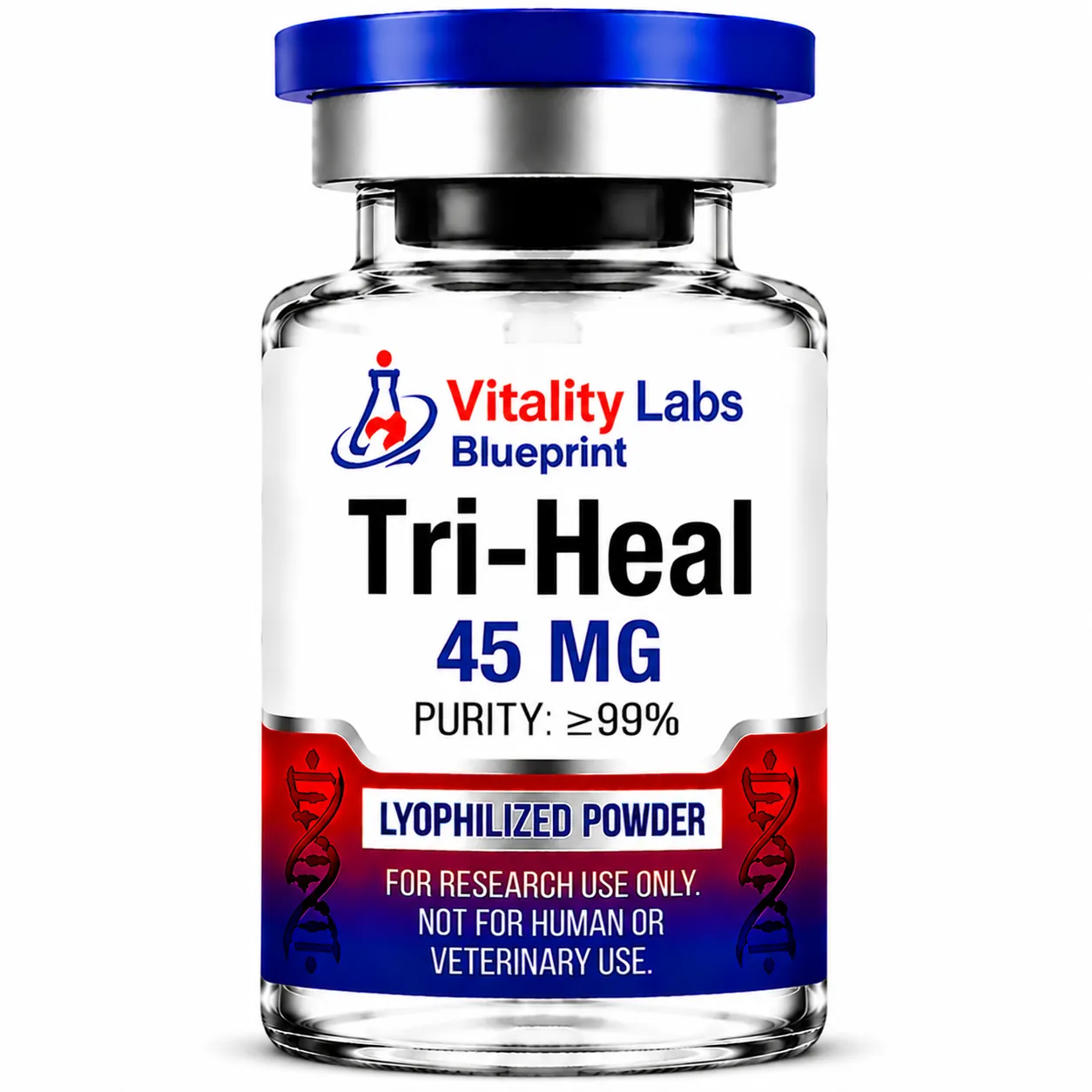
Tri-Heal is a research peptide blend combining TB-500 (25 mg), BPC-157 (10 mg), and KPV (10 mg) for advanced tissue repair and inflammation modulation. TB-500 is a synthetic fragment of thymosin β4, a 43-amino-acid peptide involved in cell migration, angiogenesis, and wound healing. BPC-157 is a synthetic 15-amino-acid body protection compound with pro-angiogenic and gastroprotective properties. KPV (Lys-Pro-Val) is a tripeptide derived from α-MSH noted for potent anti-inflammatory effects. This educational protocol presents a once-daily subcutaneous approach using a practical dilution for accurate measurements.
| Week | Daily Amount | Units (per administration) | Volume |
|---|---|---|---|
| Weeks 1–2 | 500 mcg | 3.3 units* | 0.033 mL |
| Weeks 3–4 | 1000 mcg | 6.7 units* | 0.067 mL |
| Weeks 5–6 | 1500 mcg | 10 units | 0.10 mL |
| Weeks 7–8 | 2000 mcg | 13.3 units | 0.133 mL |
Frequency: Administer once daily subcutaneously. This schedule uses the largest practical dilution (3.0 mL) to optimize measurement accuracy across all daily amounts.
Precision Note: For administrations ≤10 units (≤0.10 mL), consider using 30-unit or 50-unit measuring devices for improved readability and accuracy.
| Week | Daily Amount | Units (per administration) | 0.167 mL |
|---|---|---|---|
| Weeks 1–2 | 500 mcg | 3.3 units | 0.033 mL |
| Weeks 3–4 | 1000 mcg | 6.7 units | 0.067 mL |
| Weeks 5–6 | 1500 mcg | 10 units | 0.10 mL |
| Weeks 7–8 | 2000 mcg | 13.3 units | 0.133 mL |
| Weeks 9–10 | 2500 mcg | 16.7 units | 0.167 mL |
| Weeks 11–12 | 3000 mcg | 20 units | 0.20 mL |
| Week | Daily Amount | Units (per administration) | Volume |
|---|---|---|---|
| Weeks 1–2 | 500 mcg | 3.3 units | 0.033 mL |
| Weeks 3–4 | 1000 mcg | 6.7 units | 0.067 mL |
| Weeks 5–6 | 1500 mcg | 10 units | 0.10 mL |
| Weeks 7–8 | 2000 mcg | 13.3 units | 0.133 mL |
| Weeks 9–10 | 2500 mcg | 16.7 units | 0.167 mL |
| Weeks 11–12 | 3000 mcg | 20 units | 0.20 mL |
| Weeks 13–14 | 3500 mcg | 23.3 units | 0.233 mL |
| Weeks 15–16 | 4000 mcg | 26.7 units | 0.267 mL |
Reconstitution Steps
Important: This guide is for educational purposes only and is not medical advice. For research use only. Not for human consumption.
Plan based on an 8–16 week daily protocol with gradual titration.
Concise summary of the once-daily regimen.
Suggested daily titration approach.
Proper storage preserves peptide quality and potency.
Practical considerations for consistency and safety.
Tri-Heal combines three peptides with complementary mechanisms targeting multiple aspects of tissue injury repair.
TB-500 (Thymosin β4): Acts as a natural repair factor, inhibiting inflammation and apoptosis while promoting angiogenesis, cell migration, and matrix remodeling. This 43-amino-acid peptide has been shown to accelerate dermal healing in preclinical models and clinical applications.
BPC-157 (Body Protection Compound): Enhances healing through VEGFR2/Akt-eNOS activation, increasing nitric oxide production and angiogenesis while stimulating fibroblast activity. This 15-amino-acid gastric peptide supports tendon, muscle, and gastrointestinal tissue repair.
KPV (Lys-Pro-Val): Provides anti-inflammatory effects by reducing NF-κB activation and attenuating pro-inflammatory cytokine signaling in epithelial and immune cells. This α-MSH-derived tripeptide complements the regenerative actions of TB-500 and BPC-157.
Together, these three peptides target wound repair, angiogenesis, and inflammation through complementary mechanisms.
Observations from preclinical and clinical literature on the individual components.
General subcutaneous guidance from clinical best-practice resources.
This content is intended for therapeutic educational purposes only and does not constitute medical advice, diagnosis, or treatment. For research use only. Not for human consumption.
— The regenerative peptide thymosin β4 accelerates dermal healing in preclinical models and patients.
— Emerging Use of BPC-157 in Orthopaedic Sports Medicine: A Systematic Review.
— Orally Targeted Delivery of Tripeptide KPV via HA-Functionalized Nanoparticles Alleviates Ulcerative Colitis
— Recommendations for the Generation, Quantification, Storage, and Handling of Peptides Used for Mass Spectrometry-Based Assays
— Vaccine Administration: subcutaneous route technique, angle, and site guidance
— Progress on the Function and Application of Thymosin β4
— Regeneration or Risk? A Narrative Review of BPC-157 for Musculoskeletal Healing
— Gastric pentadecapeptide BPC 157 accelerates healing of transected rat Achilles tendon and stimulates tendocyte growth
— Technique diagram and site guidance for subcutaneous administration
— Best practices for parenteral administration: asepsis, preparation, and administration
— Pharmacologic considerations of the subcutaneous route