
This Selank guide explains how a 5 mg vial can be calculated for intranasal research with a verified 0.10 mL metered actuator. Published human Selank studies primarily used intranasal drops or measured intranasal solution. A measured 5 mL final volume provides 100 mcg per spray, while a measured 10 mL final volume provides 50 mcg per spray.
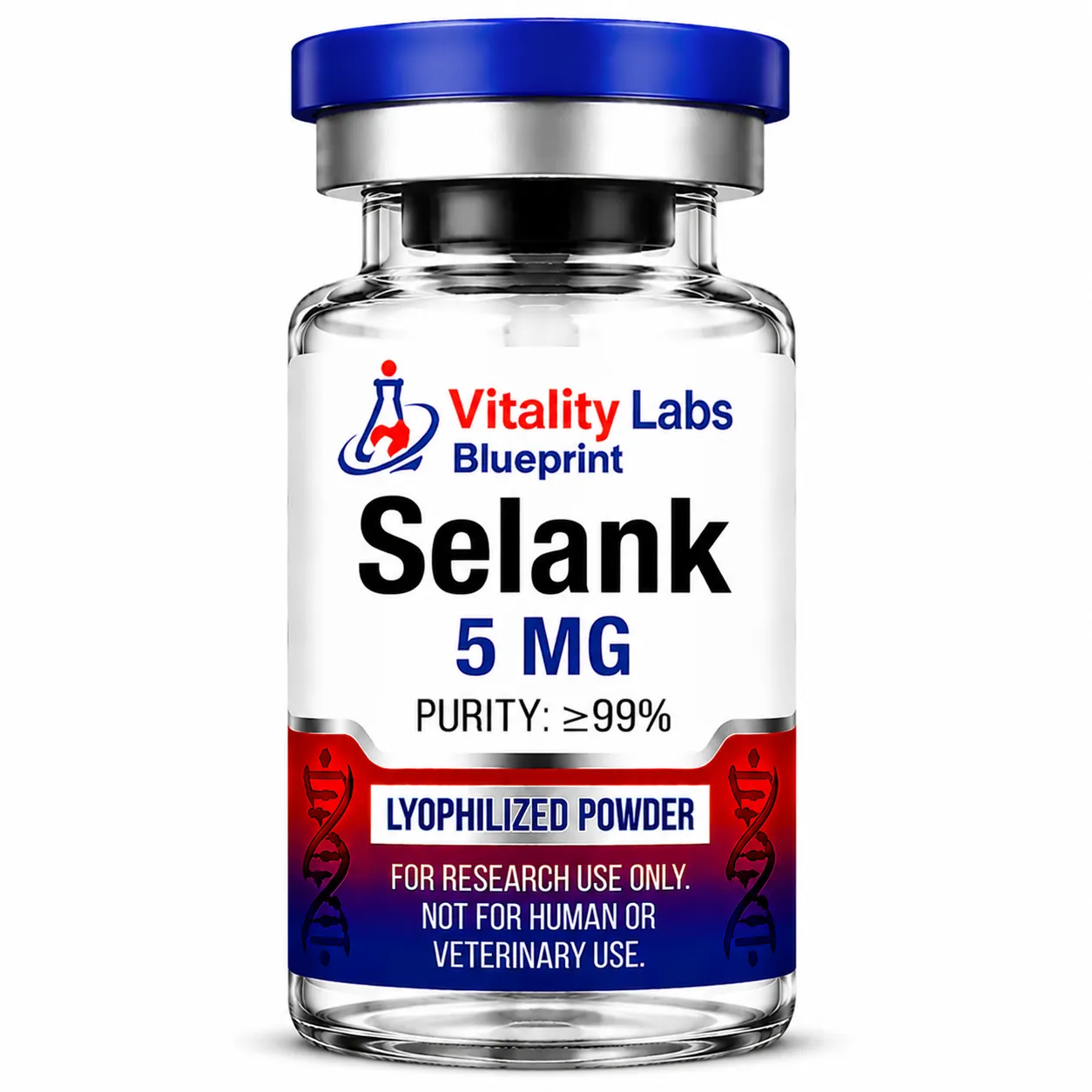
Research context: Human studies used different amounts, durations, and manufactured drop formulations.
Selank is a synthetic heptapeptide based on the naturally occurring tuftsin sequence. Human research has evaluated intranasal Selank in adults with generalized anxiety disorder, neurasthenia, and in acute neuroimaging experiments. The calculations below use the entire 5 mg vial and keep published study protocols separate from worked preparation examples.
Research context: For evidence on mechanisms, human and preclinical research, limitations, and safety, read Selank Peptide: Benefits, Uses, Side Effects, Research Guide.
Selank 5 mg intranasal research calculations for 5 mL and 10 mL final volumes
Both options begin with 3.0 mL in the peptide vial. Transfer the complete solution, then add enough vehicle to reach the measured final volume.
| Measured Final Volume | Vehicle Added After Transfer | Final Concentration | Per Verified 0.10 mL Spray |
|---|---|---|---|
| 5.0 mL | About 2.0 mL | 1,000 mcg/mL | 100 mcg 50 nominal sprays |
| 10.0 mL | About 7.0 mL | 500 mcg/mL | 50 mcg 100 nominal sprays |
How to Prepare the 5 mL or 10 mL Research Bottle
| Literature Amount | 5 mL Option (100 mcg per Spray) | 10 mL Option (50 mcg per Spray) |
|---|---|---|
| 300 mcg | 3 sprays | 6 sprays |
| 900 mcg | 9 sprays | 18 sprays |
| 2700 mcg | 27 sprays | 54 sprays |
Note: These rows are concentration conversions, not a universal schedule. The larger actuation counts show why amounts reported with a manufactured drop formulation should not be treated as direct generic-pump instructions.
Important: Use the measured final volume and verified actuator output in every calculation. Bottle capacity alone not establish the final volume or the amount delivered per spray.
| Source | Research Context | Published Intranasal Amount and Formulation |
|---|---|---|
| Zozulia et al., 2008 | 62 adults with generalized anxiety disorder or neurasthenia | Selank 0.15% nasal drops at 2.7 mg per day, reported as 36 drops divided across three administrations, with outcomes followed through day 14. |
| Syunyakov et al., 2012 | 20 adults with generalized anxiety disorder | 2,700 mcg per day intranasally. The pharmaco-EEG analysis also examined a single 900 mcg exposure. |
| Panikratova et al., 2020 | Healthy-volunteer functional connectivity study | One intranasal exposure using 0.15% Selank solution, 60 microliters per nostril, described as a 0.2 mg total amount. |
Reported Selank formulations may vary by concentration, excipients, delivery method, and preparation. Amounts reported in published research should not be treated as direct equivalents to a different metered pump system.
Reference concentration: Mathematically, 5 mg brought to about 3.33 mL equals 1.5 mg/mL. A verified 0.10 mL actuation at that concentration contains 150 mcg. This is a concentration comparison, not of any specific finished formulation.
mcg per spray = (5,000 mcg / final volume in mL) × verified mL per spray
Nominal sprays = final volume in mL / verified mL per spray
| Verified Actuator Output | 5 mL Option (1,000 mcg/mL) | 10 mL Option (500 mcg/mL) |
|---|---|---|
| 0.05 mL | 50 mcg | 25 mcg |
| 0.10 mL | 100 mcg | 50 mcg |
| 0.13 mL | 130 mcg | 65 mcg |
Quick reference for the intranasal Selank 5 mg calculation.
Storage depends on the complete formulation, container, and handling method.
Selank is a synthetic heptapeptide based on the tuftsin sequence. Human studies have examined anxiety-related clinical measures, leu-enkephalin metabolism, EEG response patterns, and functional brain connectivity after Selank exposure.
Intranasal drops or solution are the delivery methods reported in the primary human research summarized on this page.
The vial calculation is concentration based. Dividing 5,000 mcg by the measured final volume gives mcg per mL. Multiplying that concentration by the verified pump output gives mcg per spray.
Consistent technique improves the value of recorded research observations.
The following information provides general educational context related to scientific discussions and available background materials.
– Human comparative study of Selank in adults with generalized anxiety disorder or neurasthenia. The study reports the 0.15% nasal-drop protocol and 2.7 mg daily amount.
— Rapid and slow response during treatment of generalized anxiety disorder with peptide anxiolytic Selank. Reports 2,700 mcg per day intranasally and a 900 mcg pharmaco-EEG exposure.
– Analytical challenges and regulatory requirements for nasal in Europe and the United States. Reviews pump output and device variables.