
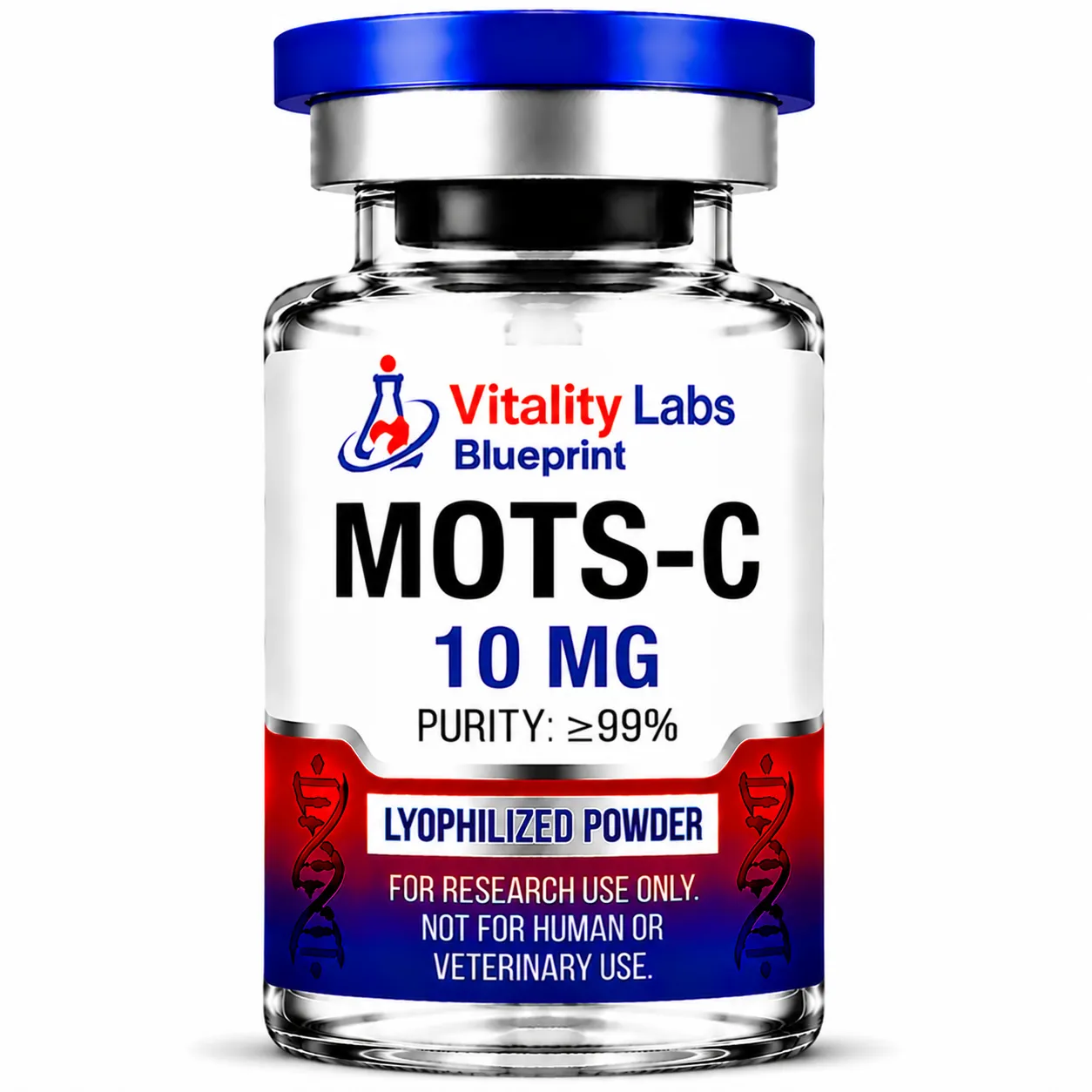
Educational guide for preparation and daily reference information
| Week | Daily Research (mcg) | Units (mL) |
|---|---|---|
| Weeks 1–2 | 200 mcg (0.2 mg) | 6 units (0.06 mL) |
| Weeks 3–4 | 400 mcg (0.4 mg) | 12 units (0.12 mL) |
| Weeks 5–6 | 600 mcg (0.6 mg) | 18 units (0.18 mL) |
| Weeks 7–8 | 800 mcg (0.8 mg) | 24 units (0.24 mL) |
| Weeks 9–10+ | 1,000 mcg (1.0 mg) | 30 units (0.30 mL) |
Preparation Steps
Plan based on an 8–12 week daily research schedule with gradual adjustment.
Concise summary of the once-daily research schedule.
Suggested daily adjustment approach based on available research references.
Proper storage preserves peptide quality and stability.
Practical considerations for consistency and safety.
Observations from preclinical literature (no human clinical trials completed to date).
Complementary strategies for supporting outcomes based on MOTS-C metabolic mechanisms.
General subcutaneous guidance from clinical best-practice resources.
— The mitochondrial-derived peptide MOTS-C promotes metabolic homeostasis and reduces obesity and insulin resistance (Lee C, Zeng J, Drew BG, et al.)
— Mitochondria-derived peptide MOTS-C: effects and mechanisms related to stress, metabolism and aging (Wan W, Zhang L, Lin Y, et al.)
— MOTS-C peptide regulates metabolic homeostasis to prevent ovariectomy-induced metabolic dysfunction (Hu Y, Wei W, Zhai Y, et al.)
— MOTS-C is an exercise-induced mitochondrial-encoded regulator of age-dependent physical decline and muscle homeostasis (Reynolds JC, Lai RW, Woodhead JST, et al.)
— Role of MOTS-C in the regulation of bone metabolism (Yi X, Hu G, Yang Y, et al.)
— MOTS-C (Cognitive Vitality Profile) — Alzheimer’s Drug Discovery Foundation (ADDF)
— What is the MOTS-C peptide? — U.S. Anti-Doping Agency educational article
— Mitochondrial-encoded peptide MOTS-C prevents pancreatic islet cell senescence to delay diabetes (Kong BS, Lee H, Ly S, et al.)
— Subcutaneous (SQ) application guidance — patient instructions for proper technique