
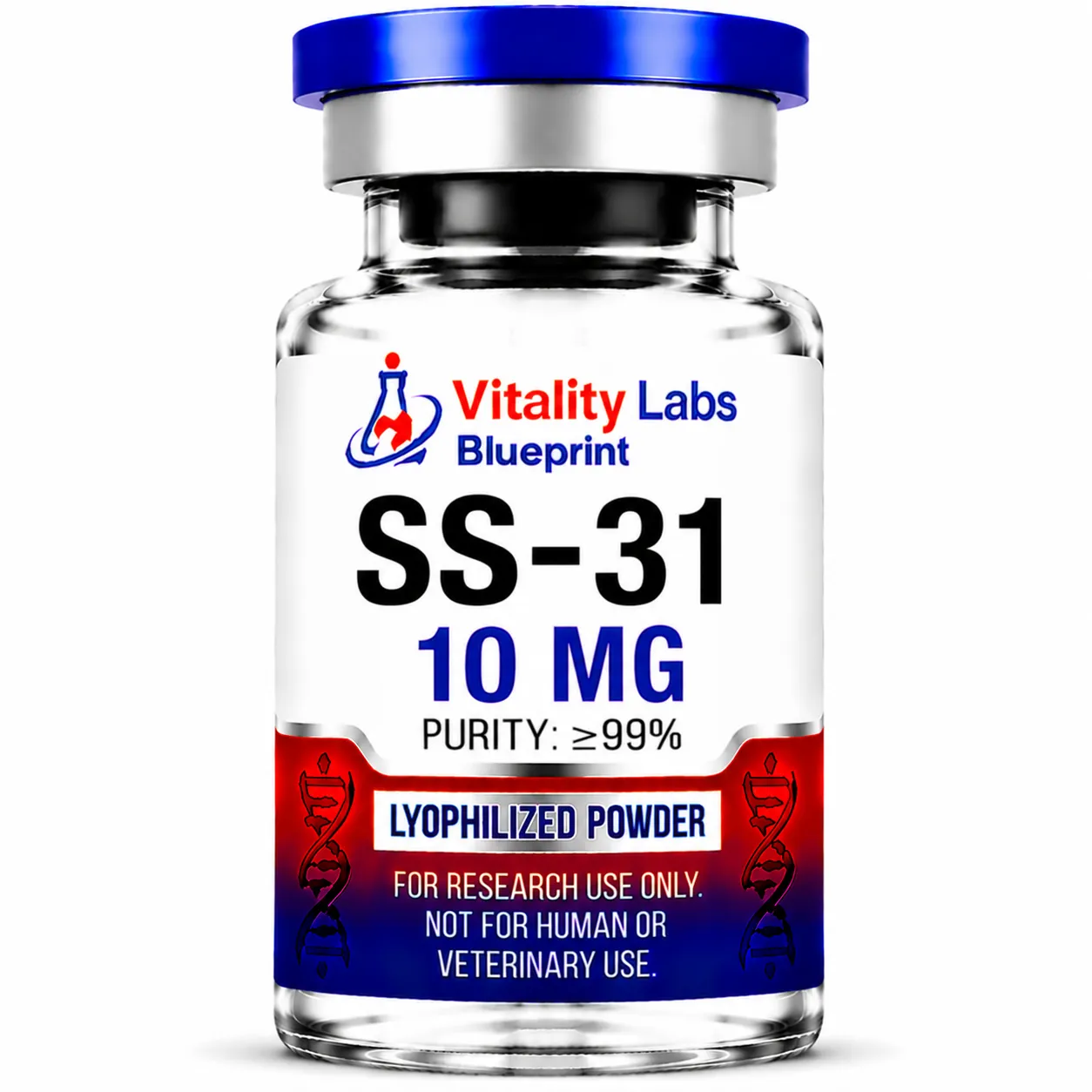
SS-31 (10 mg Vial) Research Protocol

SS-31 Research Information

SS-31 is commonly studied at 5–10 mg daily using subcutaneous administration in educational research protocols. A 10 mg vial reconstituted with bacteriostatic water yields approximately 10 mg/mL. This information is provided for research and educational purposes only.
SS-31 (elamipretide) is a mitochondria-targeted tetrapeptide that selectively binds cardiolipin in the inner mitochondrial membrane[1], helping support electron transport chain function while reducing reactive oxygen species production and supporting ATP synthesis[2]. It has been investigated in preclinical models of heart failure, neurodegenerative disease, and age-related muscle atrophy, and received FDA accelerated approval in 2025 for Barth syndrome[3]. This educational research protocol presents a once-daily subcutaneous administration approach using a concentrated reconstitution for practical insulin syringe measurements.
Research context: For evidence on mechanisms, human and preclinical research, limitations, and safety, read SS-31 Peptide: Benefits, Uses, Side Effects, and Research Information.
Educational guide for reconstitution and daily research administration.

Standard Research Approach (1 mL = 10 mg/mL)

WeekDaily AnountOld UnitsNew Units
Weeks 1–2200 µg12 units (0.12 mL)6 units (0.06 mL)
Weeks 3–4300 µg18 units (0.18 mL)9 units (0.09 mL)
Weeks 5–6400 µg24 units (0.24 mL)12 units (0.12 mL)
Weeks 7–8500 µg30 units (0.30 mL)15 units (0.15 mL)

Frequency: Administer once daily by subcutaneous administration at a consistent time. This concentrated reconstitution (1.0 mL per 10 mg vial) keeps standard research amounts within a single insulin syringe for convenient and accurate measurement.

Reconstitution Steps

Advanced Research Approach (1 mL = 10 mg/mL)
WeekDaily AnountOld UnitsNew Units
Weeks 1–2200 µg12 units (0.12 mL)6 units (0.06 mL)
Weeks 3–4300 µg18 units (0.18 mL)9 units (0.09 mL)
Weeks 5–6400 µg24 units (0.24 mL)12 units (0.12 mL)
Weeks 7–8500 µg30 units (0.30 mL)15 units (0.15 mL)
Note: Higher research amounts (15–20 mg/day) have been evaluated in limited short-term clinical research for severe mitochondrial conditions[4][5]. Research amounts above 10 mg require two separate subcutaneous administrations at different sites. Clinical studies have not extensively evaluated SS-31 beyond 12 weeks, so longer research periods require appropriate monitoring.
Important: This guide is provided for research and educational purposes only and does not constitute medical advice. SS-31 is intended for research use only and is not intended for human consumption.

Plan based on an 8–12 week daily research protocol with a gradual approach.

Concise summary of the once-daily subcutaneous regimen.

Suggested daily titration approach based on clinical trial protocols.

Proper storage preserves peptide stability and potency.

Practical considerations for consistency, safety, and tolerability.

SS-31 (elamipretide) is a cell-permeable tetrapeptide with a unique mechanism of action targeting mitochondrial dysfunction. The peptide selectively accumulates in the inner mitochondrial membrane where it binds to cardiolipin, a specialized phospholipid essential for organizing electron transport chain supercomplexes and maintaining cristae structure. By stabilizing cardiolipin-protein interactions, SS-31 optimizes electron transport efficiency, reduces pathological reactive oxygen species generation, and enhances ATP synthesis in metabolically active tissues.

Preclinical research demonstrated that SS-31 protects against mitochondrial dysfunction across multiple disease models including heart failure, ischemia-reperfusion injury, neurodegeneration, chronic kidney disease, and age-related muscle atrophy. In human clinical trials, SS-31 showed favorable safety and tolerability profiles with no dose-limiting toxicities. While Phase II trials in heart failure and primary mitochondrial myopathy did not meet primary efficacy endpoints, the TAZPOWER trial in Barth syndrome demonstrated significant improvements in muscle strength and six-minute walk distance, leading to FDA accelerated approval in 2025.

Observations from preclinical models and human clinical trials.

Complementary strategies to support mitochondrial health and optimize outcomes.

General subcutaneous administration guidance from clinical best-practice resources.

This content is intended for therapeutic educational purposes only and does not constitute medical advice, diagnosis, or treatment. SS-31 is currently FDA-approved only for Barth syndrome under the brand name Forzinity; use for other conditions remains investigational. Always consult with qualified healthcare professionals before beginning any peptide protocol. This information is provided for research and educational purposes only.

The following information provides general educational context related to scientific discussions and available background materials.

International Journal of Molecular Sciences (MDPI)

— Elamipretide: comprehensive review of structure, mechanism of action, and therapeutic potential

British Journal of Pharmacology (PMC)

— Cardiolipin-binding mechanism and mitochondrial membrane stabilization by SS-31

U.S. Food & Drug Administration (FDA)

— FDA grants accelerated approval to elamipretide (Forzinity) as first treatment for Barth syndrome (2025)

Journal of the American College of Cardiology (JACC)

— PROGRESS-HF trial: safety and tolerability of elamipretide in heart failure patients

Neurology (AAN Journals)

— MMPOWER-2 trial: elamipretide in primary mitochondrial myopathy.

Genetics in Medicine (Nature)

— TAZPOWER trial: efficacy and safety of elamipretide in Barth syndrome

Biochimica et Biophysica Acta (BBA) – Bioenergetics

— Cardiolipin remodeling and cristae structure: role in mitochondrial function

Journal of Cardiovascular Pharmacology (PMC)

— SS-31 reduces oxidative stress and improves mitochondrial bioenergetics

Alzheimer's Drug Discovery Foundation

— Cognitive Vitality Report: SS-31 (elamipretide) preclinical and clinical overview

Orphanet Journal of Rare Diseases (PMC)

— Barth syndrome: clinical presentation, diagnosis, and emerging therapies

Centers for Disease Control and Prevention (CDC)

— Vaccine administration: subcutaneous administration technique (angle, site selection, no aspiration)

Johns Hopkins Arthritis Center

— Patient guide: how to perform subcutaneous administration (step-by-step instructions)

NCBI Bookshelf (StatPearls)

— Best practices for administration: aseptic technique, preparation, and administration

Pharmacologic Considerations of Subcutaneous Drug Administration (PMC)

— Site rotation, absorption kinetics, and prevention of lipohypertrophy