
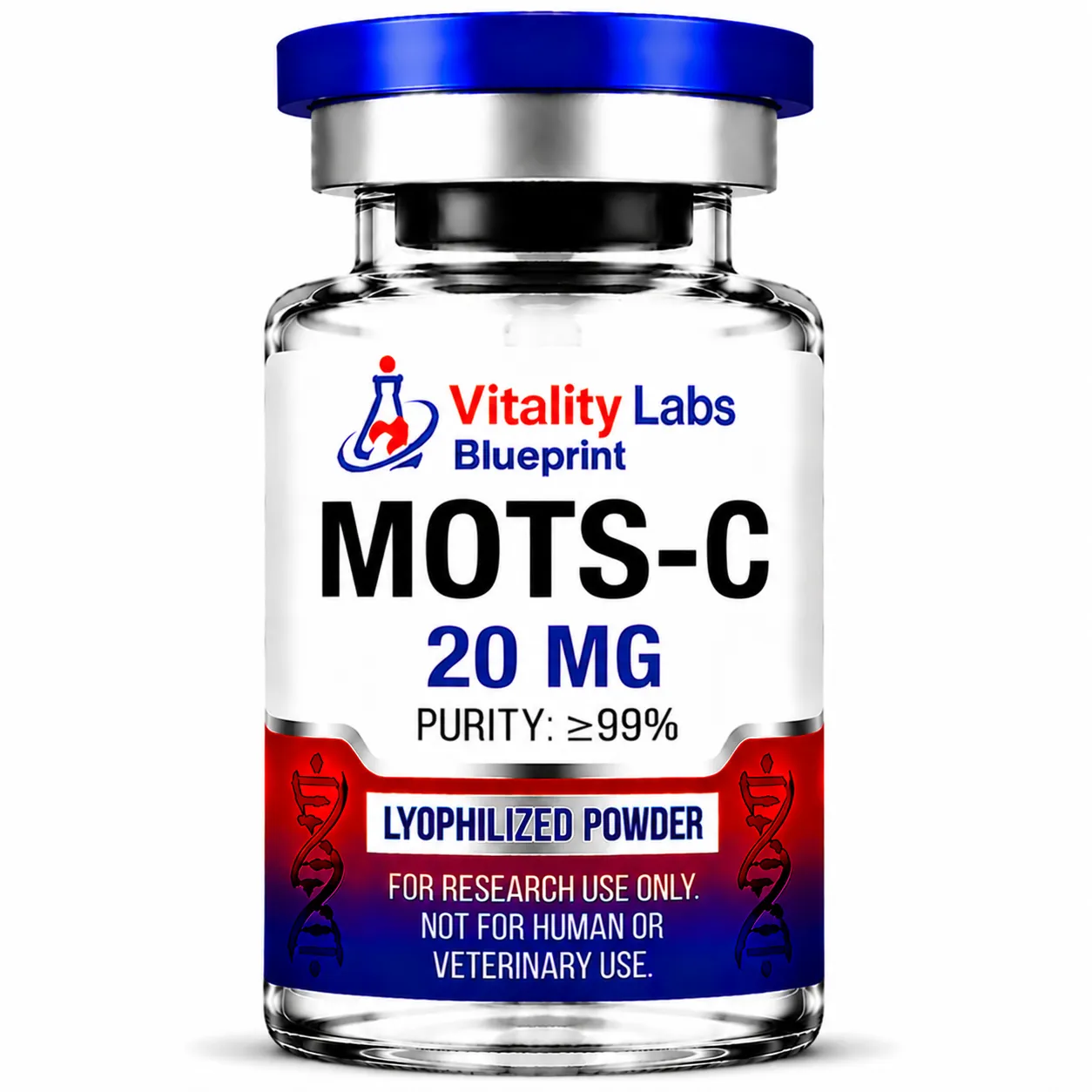
MOTS-C (20 mg Vial)

MOTS-C Research Reference

MOTS-C is referenced at 200 mcg–1 mg daily via subcutaneous application in educational research settings. A 20 mg vial prepared with bacteriostatic water provides approximately 6.67 mg/mL. Research references describe gradual adjustment over roughly 10 weeks. This information is provided for research and educational use only.
MOTS-C is a 16-amino-acid mitochondrial-derived peptide (MDP) that acts as a metabolic regulator, primarily through AMPK activation. Preclinical studies show roles related to insulin sensitivity, fat oxidation, exercise capacity, and age-related metabolic pathways. No clinical trials have been completed in humans to date. This educational reference presents a once-daily subcutaneous approach with gradual adjustment.
Research context: For evidence on mechanisms, human and preclinical research, limitations, and safety information, read MOTS-C Peptide: Benefits, Uses, Research Background.

Educational guide for preparation and daily reference information

Standard / Gradual Approach (3 mL = ~6.67 mg/mL)

WeekDaily Amount (mcg)Units (per administration) (mL)
Weeks 1–2200 mcg (0.2 mg)3 units (0.03 mL)
Weeks 3–4400 mcg (0.4 mg)6 units (0.06 mL)
Weeks 5–6200 mcg600 mcg (0.6 mg)12 units (0.12 mL)
Weeks 7–8250 mcg800 mcg (0.8 mg)12 units (0.12 mL)
Weeks 9–10+1,000 mcg (1.0 mg)15 units (0.15 mL)
Frequency: Apply once daily subcutaneously. Stay at each reference level for approximately 2 weeks before increasing, and monitor for any adverse responses.

For ≤10-unit (≤0.10 mL) applications, consider 30- or 50-unit measurement devices for improved readability.

Preparation Steps

Important: This guide is for educational purposes only and is not medical advice.

Plan based on an 8–16 week daily research schedule with gradual adjustment.

Concise summary of the once-daily research schedule.

Suggested daily adjustment approach based on animal-to-human research references.

Proper storage preserves peptide quality and stability.

Allow containers to reach room temperature before opening to reduce condensation uptake.

Practical considerations for consistency and safety.

MOTS-C functions as a metabolic “stress signal” that helps optimize energy usage during nutrient stress or exercise. Its primary mechanism is AMPK activation through inhibition of the folate cycle, causing accumulation of AICAR (an AMP analog). Activated AMPK shifts cells into an energy-efficient mode — enhancing glucose uptake, fatty-acid oxidation, and mitochondrial respiration while downregulating fat storage and gluconeogenesis. MOTS-C can also translocate to the cell nucleus under stress conditions and regulate antioxidant and stress-response genes. This retrograde signaling from mitochondria to nucleus increases expression of cytoprotective enzymes, helping cells cope with oxidative stress. Research indicates MOTS-C may also influence mTOR and inflammatory pathways, contributing to lifespan and healthspan effects. Its actions resemble those of exercise and metformin at a cellular level, making it of interest for metabolic disorders, obesity, and aging research.

Observations from preclinical literature (no human clinical trials completed to date).

Complementary strategies for best outcomes based on MOTS-C’s metabolic mechanisms.

General subcutaneous guidance from clinical best-practice resources.

This content is intended for therapeutic educational purposes only and does not constitute medical advice, diagnosis, or treatment. MOTS-C is an experimental compound; no clinical trials have been completed in humans. Always consult qualified healthcare providers before starting any new therapy.

Cell Metabolism (2015)

— The mitochondrial-derived peptide MOTS-C promotes metabolic homeostasis and reduces obesity and insulin resistance (Lee C, Zeng J, Drew BG, et al.)

Journal of Translational Medicine (2023)

— Mitochondria-derived peptide MOTS-C: effects and mechanisms related to stress, metabolism and aging (Wan W, Zhang L, Lin Y, et al.)

Journal of Molecular Medicine (2019)

— MOTS-C peptide regulates adipose homeostasis to prevent ovariectomy-induced metabolic dysfunction (Lu H, Wei M, Zhai Y, et al.)

Nature Communications (2021)

— MOTS-C is an exercise-induced mitochondrial-encoded regulator of age-dependent physical decline and muscle homeostasis (Reynolds JC, Lai RW, Woodhead JST, et al.)

Frontiers in Physiology (2023)

— Role of MOTS-C in the regulation of bone metabolism (Yi X, Hu G, Yang Y, et al.)

USADA Spirit of Sport (2023)

— What is the MOTS-C peptide? – U.S. Anti-Doping Agency education article

CDC Vaccine Administration Guidelines

— Subcutaneous route guidance (angle, site selection, no aspiration)