
MOTS-C is studied at 200 mcg–1 mg in educational research settings. A 40 mg vial prepared with bacteriostatic water yields about 13.33 mg/mL. Most research approaches explore gradual increases over roughly 10 weeks. This information is for research and educational use only.
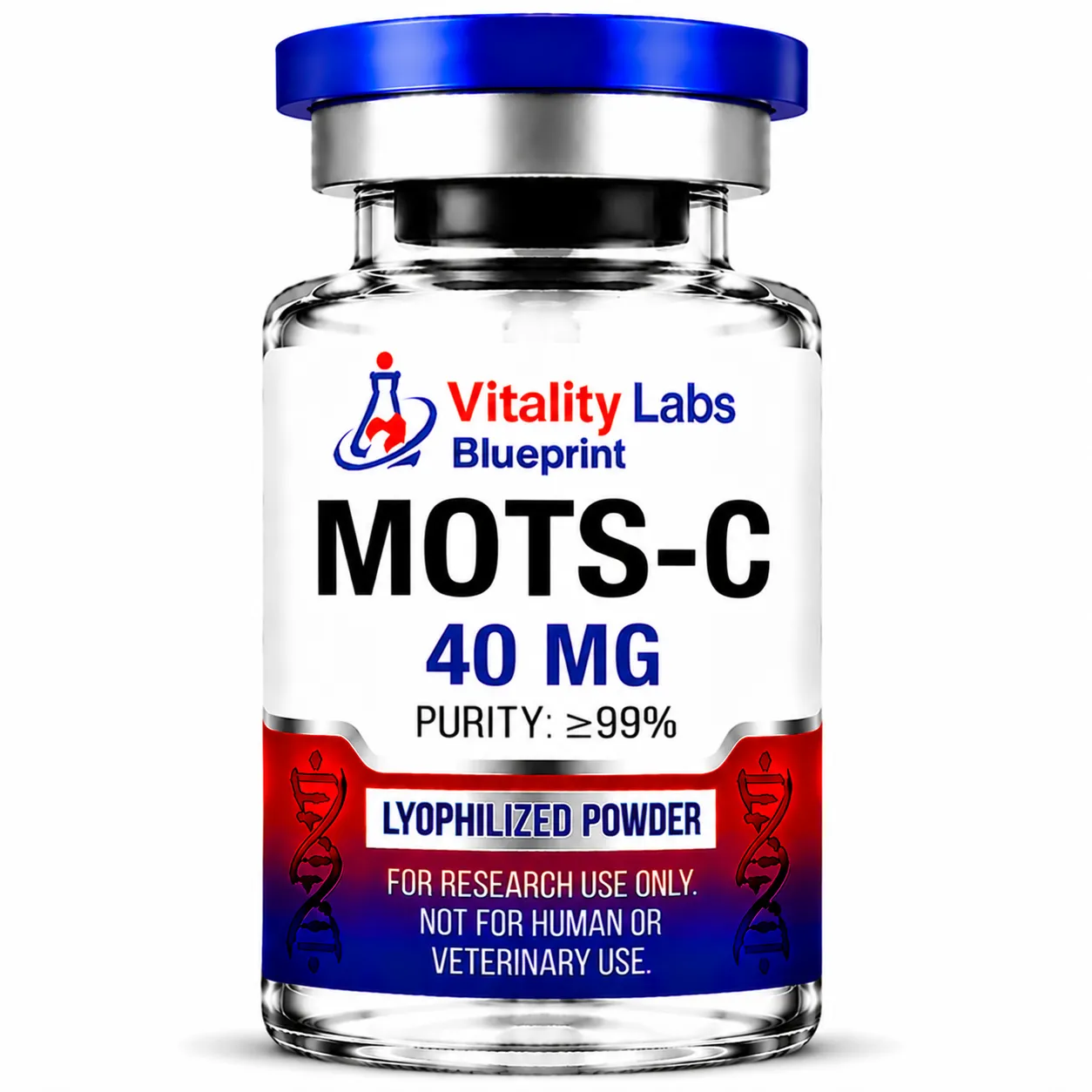
MOTS-C is a 16–amino-acid mitochondrial-derived peptide (MDP) that acts as a metabolic regulator, primarily through AMPK activation. Preclinical studies show it enhances insulin sensitivity, promotes fat oxidation, improves exercise capacity, and supports age-related metabolic research. No clinical trials have been completed in humans to date. This educational material presents a once-daily subcutaneous approach with gradual progression.
Educational guide for research preparation and daily administration
| Week | Daily Amount (mcg) | Units (per administration) (mL) |
|---|---|---|
| Weeks 1–2 | 200 mcg (0.2 mg) | 1.5 units (0.015 mL) |
| Weeks 3–4 | 400 mcg (0.4 mg) | 3 units (0.03 mL) |
| Weeks 5–6 | 600 mcg (0.6 mg) | 4.5 units (0.045 mL) |
| Weeks 7–8 | 800 mcg (0.8 mg) | 6 units (0.06 mL) |
| Weeks 9–10+ | 1,000 mcg (1.0 mg) | 7.5 units (0.075 mL) |
Preparation Steps
Important: This guide is for educational purposes only and is not medical advice. For research use only. Not for human consumption.
Plan based on an 8–16 week daily research schedule with gradual progression.
Concise summary of the once-daily regimen.
Suggested daily progression approach based on animal-to-human research observations.
Proper storage preserves peptide quality and potency.
Allow vials to reach room temperature before opening to reduce condensation uptake.
Practical considerations for consistency and safety.
Observations from preclinical literature (no human clinical trials completed to date).
Complementary strategies for best outcomes based on MOTS-C’s metabolic mechanisms.
General subcutaneous guidance from clinical best-practice resources.
— The mitochondrial-derived peptide MOTS-C promotes metabolic homeostasis and reduces obesity and insulin resistance (Lee C, Zeng J, Drew BG, et al.)
— Mitochondria-derived peptide MOTS-C: effects and mechanisms related to stress, metabolism and aging (Wan W, Zhang L, Lin Y, et al.)
— MOTS-C peptide regulates adipose homeostasis to prevent ovariectomy-induced metabolic dysfunction (Lu H, Wei M, Zhai Y, et al.)
— MOTS-C is an exercise-induced mitochondrial-encoded regulator of age-dependent physical decline and muscle homeostasis (Reynolds JC, Lai RW, Woodhead JST, et al.)
— Role of MOTS-C in the regulation of bone metabolism (Yi X, Hu G, Yang Y, et al.)
— MOTS-C (Cognitive Vitality Profile) – Alzheimer’s Drug Discovery Foundation (ADDF)
— What is the MOTS-C peptide? – U.S. Anti-Doping Agency education article
— Subcutaneous route guidance (angle, site selection, no aspiration)